
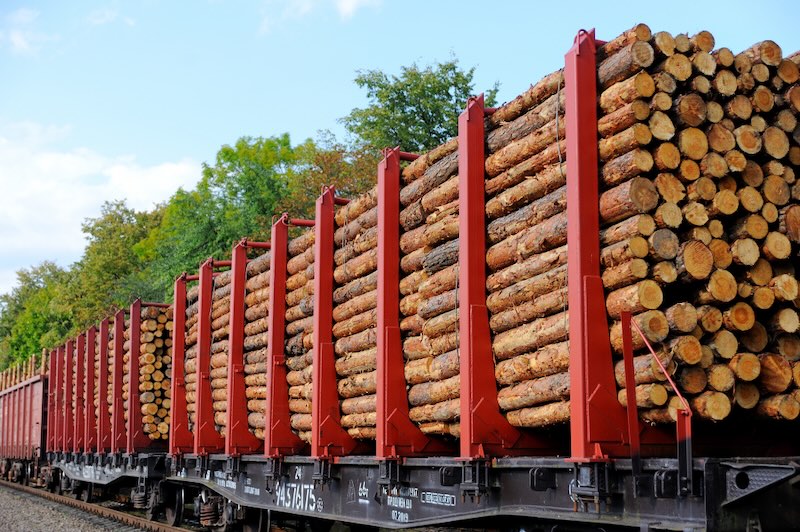

According to China Customs data, China imported a total of 14.289 million cubic meters of timber in the first quarter of 2026, down 12.7% year on year. Of this, log imports totaled 7.16 million cubic meters, down 11%, while sawnwood imports totaled 5.02 million cubic meters, down 14%.
01 Import Structure
Of China’s log imports, coniferous log imports reached 5.17 million cubic meters, down 11% year on year. The average import price was USD 243 per cubic meter, down 4%.
Broadleaf log imports totaled 1.99 million cubic meters, down 13% year on year, with an average import price of USD 551 per cubic meter, up 3%.
For sawnwood, coniferous sawnwood imports totaled 2.73 million cubic meters, down 23% year on year. The average import price was USD 426 per cubic meter, down 8%.
Broadleaf sawnwood imports reached 2.29 million cubic meters, up 0.16% year on year, with the average import price rising 8% to USD 730 per cubic meter.
China’s Log Imports, Q1 2026
| Category | Q1 2026 Volume (million m³) | YoY Change | Q1 2026 Average Price (USD/m³) | YoY Change |
|---|---|---|---|---|
| Total Log Imports | 7.16 | -11% | — | — |
| Coniferous Logs | 5.17 | -11% | 243 | -4% |
| Broadleaf Logs | 1.99 | -13% | 551 | +3% |
China’s Sawnwood Imports, Q1 2026
| Category | Q1 2026 Volume (million m³) | YoY Change | Q1 2026 Average Price (USD/m³) | YoY Change |
|---|---|---|---|---|
| Total Sawnwood Imports | 5.02 | -14% | — | — |
| Coniferous Sawnwood | 2.73 | -23% | 426 | -8% |
| Broadleaf Sawnwood | 2.29 | +0.16% | 730 | +8% |
Data source: China Customs
02 Why Timber Imports Declined in Q1
Combined Macroeconomic and Policy Factors
Factory shutdowns during the Chinese New Year holiday in February caused monthly trade volume to fall sharply by 31%. Adjustments to ocean shipping and port scheduling also affected deliveries. Meanwhile, domestic wood-processing companies proactively reduced inventories and scaled back large-volume purchasing.
Continued Weakness in Downstream Demand
Fewer new real estate construction starts, continued weakness in the construction sector, and subdued spending on furniture and home improvement directly reduced demand for timber.
Demand for construction timber such as radiata pine and spruce declined particularly sharply.
Increasing Domestic Timber Supply
China’s domestic timber production has continued to rise steadily, driven by factors including plantation forests entering a peak rotation and harvesting cycle and the concentrated supply of timber from national reserve forest projects.
03 Changes in Key Supplier Markets
New Zealand
New Zealand remains China’s largest supplier of logs.
In the first quarter, China imported 3.886 million cubic meters of logs from New Zealand, down 7% year on year. The value of these imports fell 13% to USD 446 million, while the average price declined 11% to USD 115 per cubic meter.
Analysis: Weak demand in China, rising fuel and transportation costs in New Zealand, a shift by the country’s forestry sector toward higher-value-added processing, and efforts to develop emerging markets such as India may lead to a continued contraction in New Zealand’s log exports over the medium to long term.
Russia
Russia remains China’s largest supplier of imported sawnwood. China imported 1.935 million cubic meters of Russian sawnwood in the first quarter, down 28.7% year on year.
Analysis: From 2021 to 2025, China’s sawnwood imports from Russia remained relatively stable overall, although they declined moderately in response to market conditions. Imports fell from 14.214 million cubic meters in 2021 to 11.212 million cubic meters in 2025. With imports reaching 1.935 million cubic meters in Q1 2026, the gradual downward trend has continued.
United States
China imported 152,000 cubic meters of logs from the United States in the first quarter, down 56% year on year. Sawnwood imports totaled 188,000 cubic meters, down 32%.
Analysis: Following China’s ban on U.S. log imports in March 2025, China’s imports of U.S. logs fell sharply by 82% during the year. The ban was lifted in November, and imports are currently still in the recovery phase, with volumes potentially rebounding in the second half of 2026.
In addition, tariff policies, China-U.S. trade frictions, and other external factors contributed to the sharp year-on-year decline in U.S. sawnwood shipments to China.
Canada
China imported 322,000 cubic meters of Canadian logs in the first quarter, down 3.8% year on year. Sawnwood imports reached 295,000 cubic meters, up 26%.
Analysis: Tariff barriers affecting softwood lumber trade between the United States and Canada have significantly increased tariffs on Canadian timber entering the U.S. market. With exports to the United States constrained, more Canadian timber resources have been redirected to China, contributing to higher Chinese imports from Canada.
Germany
China imported 88,700 cubic meters of logs from Germany in the first quarter, down 60% year on year.
Germany’s ranking among China’s log suppliers fell from 8th in Q1 2025 to 11th in Q1 2026.
Analysis: The large-scale clearing of insect-damaged timber has largely come to an end, while Germany is facing a structural shortage of domestic timber. Supply is also being prioritized within the European Union. Export prices have reached record highs, with the average price increasing 26% year on year.
Tropical Logs
In the first quarter of 2026, Papua New Guinea and the Solomon Islands remained China’s two largest suppliers of tropical logs, together accounting for 68% of China’s total tropical log imports.
China’s imports from Papua New Guinea and the Solomon Islands declined by 1% and 33%, respectively, directly contributing to a 13% decline in China’s total tropical log imports to 1.061 million cubic meters.
At the same time, imports from African countries including the Republic of the Congo, the Democratic Republic of the Congo, and the Central African Republic increased despite the overall downward trend. Imports from South American suppliers such as Suriname and Ecuador also recorded significant growth, indicating a clear trend toward diversification of sourcing channels.
Analysis: Major producing countries have tightened export policies while downstream demand in China remains weak. Reduced availability of timber resources has pushed prices higher, with average import prices for logs from a number of countries rising significantly.
Data source: China Customs
Outlook
The decline in China’s timber imports in the first quarter of 2026 resulted from the combined effects of weak domestic demand, tightening international supply, and the restructuring of global supply chains.
These trends are unlikely to reverse in the short term. The timber industry is therefore accelerating the diversification of its supply channels while simultaneously facing the dual challenges of rising costs and subdued demand.